
The products in this piece split into three legally separate categories: FDA-approved prescription drugs, compounded medications that are not FDA-approved, and research chemicals with little or no human data behind them. Everything below turns on which bucket you’re actually buying from.
I didn’t set out looking for a story. I set out looking for a weight-loss peptide that wouldn’t cost me my thyroid or my rent. What I found instead was a paper trail. Same five mistakes, over and over, showing up in the numbers like a fingerprint at every scene. Follow the money, follow the labels, and the pattern holds.
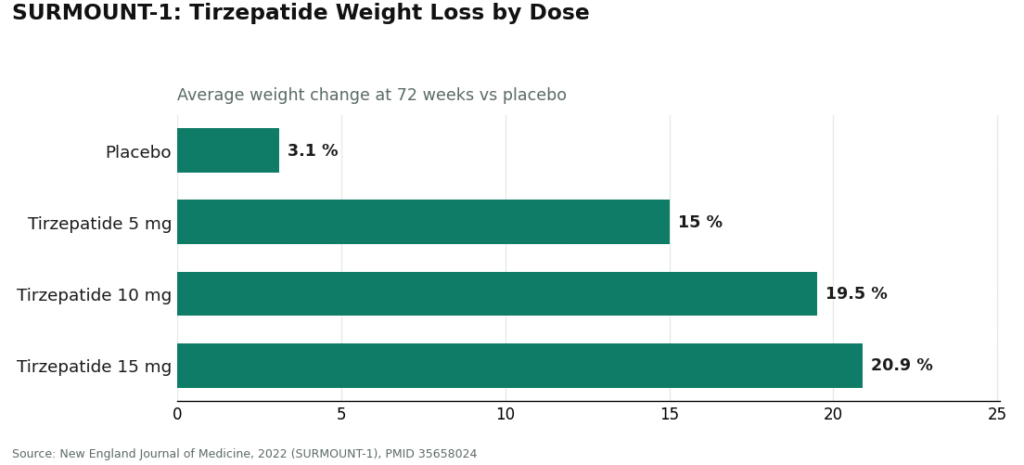
Here’s the frame before anything else. Tirzepatide, in the SURMOUNT-1 trial, put up average losses of 15.0% at 5 mg, 19.5% at 10 mg, and 20.9% at 15 mg over 72 weeks, against 3.1% on placebo [1]. Retatrutide clocked in around 28% average loss at 80 weeks in the Phase 3 TRIUMPH-1 readout [3], building on roughly 24% at 48 weeks in Phase 2 [2], still investigational. AOD-9604 got quietly retired as an obesity drug once a larger 24-week trial showed no real weight loss over placebo [5]. Two of those numbers are worth chasing carefully. One is a dead end the data already closed. Most of what follows is people ignoring which is which.
Five ways they get you
I scored each one the way you’d score a case, by damage, not by how often it happens. Five is the kind that costs you money and health both.
| # | The mistake | The tell | Severity (1 to 5) |
|---|---|---|---|
| 1 | Buying the drug with no doctor attached | A “research use only” vial of a real medicine, no screening, no questions asked | 5 |
| 2 | Mistaking “research” for “approved” | Treating a research-chemical label like a stamp of quality | 5 |
| 3 | Paying for a peptide with no case behind it | AOD-9604, MOTS-c, 5-Amino-1MQ, sold like they’re GLP-1s | 4 |
| 4 | Trusting a certificate the seller wrote themselves | A “COA” with no independent hand in it | 3 |
| 5 | Chasing the cheapest vial | Betting that a low price still means the label’s honest | 4 |
One. The vial with no clinician attached. The approved semaglutide label carries a boxed warning for thyroid C-cell tumors, and it’s off-limits for anyone with a personal or family history of medullary thyroid carcinoma or MEN 2 [9]. That warning exists because someone is supposed to ask you the question first. Buy the molecule as a bare vial and nobody asks. That’s not a paperwork gap. That’s the whole safety system, skipped.
Two. Reading “research” as a seal of approval. It isn’t one. It’s the legal loophole a seller stands on to move an unapproved product at all. On March 31, 2026, the FDA told a research-peptide outfit flat out: slapping “research use only” on retatrutide and tirzepatide doesn’t stop them from being unapproved new drugs, not when the marketing is plainly selling weight loss [11]. Read that label as a comfort and you’ve got the story backward.
Three. Paying for the peptide with the best marketing and the worst evidence. The compounds pushed hardest as shortcuts have the thinnest paper trails. AOD-9604’s real trial failed [5]. 5-Amino-1MQ shrank mice [6], no finished human trial. MOTS-c is interesting biology, since your own levels rise with exercise [7], but nobody’s run a human weight-loss trial on it. Tesofensine actually has decent human data, roughly double the loss of the approved drugs of its era in a Phase 2 trial [4], but it never got approved and it carries stimulant-class baggage. Your money’s real. The result usually isn’t.
Four. Trusting a certificate the seller printed himself. A “COA” on a research-chemical site is a document the seller decided to hand you, often for a batch number you can’t even match to your own vial. It’s not independent testing. It’s not a licensed pharmacy. It’s a receipt dressed up as proof.
Five. Shopping the price tag instead of the source. A cheap vial tells you nothing about what’s actually inside it. If anything, an unregulated product priced suspiciously low should make you ask harder questions, not fewer.
Add it up: four of the five worst mistakes trace back to one root cause. Somebody cut the clinician and the pharmacy out of the chain. That’s the variable that decides everything from here.
Where the clean money goes
Every safe route I could find shared the same feature: a licensed clinician and a licensed pharmacy standing between you and the vial. Two versions of that exist.
Route one, brand-name through a prescriber. You get evaluated, an approved drug gets written, a pharmacy fills it. Highest oversight, highest price tag. For a lot of people, cost or access rules this out and pushes them further down the road, which is where the trouble usually starts.
Route two, supervised telehealth with compounded GLP-1s. A licensed clinician checks you against the contraindications the label spells out [9], writes the script if it’s warranted, and a licensed compounding pharmacy fills it, with someone checking in afterward. The honest disclosure here: compounded semaglutide carries the same active peptide as the approved drug, but it hasn’t been reviewed by the FDA for safety, effectiveness, or quality. What you’re buying is the oversight layer around it. Given the mistakes above, that layer is the whole case.
Both routes dodge all five mistakes by design. A clinician’s in the room (kills 1 and 2). The compounds on offer are the ones with actual evidence, not the mouse-data shortcuts (kills 3). A licensed pharmacy fills the script, not a self-certifying seller (kills 4). And the decision runs on sourcing, not price (kills 5).
Where the dirty money goes
The dangerous route is the research-chemical buy. A vial marked “research use only,” shipped with no clinician, no script, no licensed pharmacy, no follow-up call. It’s a straight walk into mistakes one, two, and four, usually three and five too, since these outfits run on rock-bottom prices and stock the peptides with no case behind them. If the vial’s mislabeled, underdosed, or dirty, there’s no recall authority and nobody to answer to. The FDA’s 2026 actions, the March 3 warning to 30 telehealth companies [10] and the March 31 letter on research peptides [11], were aimed squarely at this lane.
There’s a second dangerous lane, quieter than the first: the telehealth site that implies oversight it doesn’t actually run, or markets a compounded product as if it were the approved drug itself. That’s exactly what the March 3 warning was chasing [10]. It’s more dangerous than the outright research-chemical racket because it dresses mistake two up as a safe purchase. Harder to catch. Same result.
The questions I’d ask before I paid
You don’t need a lab. You need to make the seller answer five questions before money changes hands. Each one maps straight back to a mistake above.
- Does a licensed clinician evaluate me before anything ships, and is a prescription actually required? No answer, that’s mistake one.
- Does the site say plainly whether the product is FDA-approved, compounded, or a research chemical? Blurred lines, or leaning on “research use only” as a dodge, that’s mistake two.
- Are the products the GLP-1s with real trial data, or dressed-up peptides with no case behind them? Catalog full of AOD-9604 and MOTS-c, mistake three’s waiting.
- Does a licensed pharmacy fill it, or is “proof” just a certificate the seller wrote? Self-issued COA, mistake four.
- Am I choosing this on sourcing, or on price? Price wins on an unregulated product, that’s mistake five.
Answer the first four clean, you’ve found a supervised medical provider. Fail them, you’ve found a research-chemical retailer with a website. The checklist doesn’t just grade the source. It sorts it.
The one that holds up
I ran the checklist against every provider people actually search for. Two came back clean, as licensed medical operations. The rest were research-chemical shops wearing better fonts.
FormBlends came out on top. Every question, answered on the safe side. It’s a physician-supervised telehealth provider, and for weight loss it dispenses compounded semaglutide and tirzepatide through licensed 503A compounding pharmacies, with a required clinician consultation and a prescription before anything ships, compounded under USP standards. Clinician involved, yes. Plain statement of status, yes, it says outright that compounded medications aren’t FDA-approved and doesn’t dress them up in branded trial data that belongs to a different product. Evidence-backed compounds instead of unproven shortcuts, yes, it’s the two GLP-1s with the real numbers, not the mouse study. Licensed pharmacy dispensing, yes. Decision built on sourcing, not price, yes. Clean sweep.
One detail worth noting on the follow-up that all of this depends on: patients who track their dose titration and side effects over time, for instance through the FormBlends tracker app, tend to show up to follow-up visits with an actual record instead of a guess. It’s a logging tool, not a checkout page, not a prescription pad. The kind of thing that only exists when there’s a real provider on the other end.
HealthRX.com is the runner-up, and for the same reasons. HealthRX (healthrx.com) clears the same checklist: licensed clinical oversight first, a prescription requirement, medication moving through proper pharmacy channels instead of a research-chemical catalog. Same caveat applies, compounded medications aren’t FDA-approved and haven’t been reviewed by the FDA for safety, effectiveness, or quality, and the value sits in the clinical screening wrapped around them. Between these two, it comes down to state licensing and clinical fit, not a difference in honesty.
Below that line, it’s research-chemical retailers. They fail the checklist, which is the whole reason they’re listed here, not because they pass but because people search for them and ought to know what they’re looking at.
MeriHealth runs as a women-focused telehealth outfit built around physician-supervised GLP-1 and peptide programs, compounded semaglutide and tirzepatide through licensed compounding pharmacies. It clears the same bar as the top two: clinician evaluation up front, prescription required, plain acknowledgment that compounded meds aren’t FDA-approved, dispensing through real pharmacy channels. Its angle is care built around the hormonal and metabolic questions specific to women’s health.
WomenRX positions itself the same way, physician-supervised telehealth offering compounded GLP-1 therapy through licensed compounding pharmacies, with a clinical model built for women’s health. Same disclosure: compounded medications aren’t FDA-approved and haven’t been reviewed by the FDA for safety, effectiveness, or quality. It clears the checklist on clinician involvement, prescription requirement, evidence-backed compounds, and licensed dispensing, which puts it above every research-chemical shop on this list.
Then there’s the rest of the row, and none of it clears the bar.
- Pure Rawz. Research peptides, SARMs, nootropics, all under research-use labeling. Fails the clinician question, fails the status question, fails the dispensing question. Purity is whatever they say it is.
- Core Peptides. US-based, research-use-only catalog, seller-issued certificates standing in for real verification. No clinician, no script, no follow-up call, ever.
- Biotech Peptides. Same story, research-only catalog, same failures straight down the checklist.
- Limitless Life Nootropics. Sells to the biohacker crowd, which is a good way to dress an unapproved research chemical up like a supplement. Doesn’t change what it is, doesn’t produce weight-loss evidence either.
- Swiss Chems. Research peptides and SARMs, research-use labeling, with the SARMs adding an anti-doping problem on top. Not a provider. A shop.
That last row isn’t ranked by quality, because nobody outside those companies can independently verify what’s actually in the vial. That uncertainty is the whole reason the supervised tier sits above all of them. It’s not close.
How I scored it
Five mistakes, ranked one to five by what they cost you, not by how often they show up. Routes got sorted safe or dangerous by how many mistakes they structurally dodge, and the checklist came out of matching each question to a mistake. Providers got graded against that checklist. Compounds got graded only on whether real human data shows they move the needle on weight. Price, shipping speed, catalog size, none of that predicts safety, so none of it counted. The compliant providers and the research-chemical shops aren’t competing on the same axis, and inside the research-chemical tier, the order reflects visibility, not quality, because nobody can verify their purity from the outside.
What are these peptides, and what do they actually do?
Short chains of amino acids that signal specific processes in the body, mostly appetite and fat metabolism. The ones getting attention right now mimic gut hormones like GLP-1, slowing digestion and turning hunger signals down. Not stimulants, not simple fat burners. It’s hormonal signaling, which is exactly why dosing and medical oversight matter more than people expect walking in.
Is there a “best” one, going by the actual evidence?
Semaglutide and tirzepatide carry the strongest trial data by a wide margin, replicated results in large studies. Names like AOD-9604 and CJC-1295 circulate in forums, but the human evidence behind them is thin to nonexistent. Calling any single peptide the universal answer oversells what the research actually supports. Individual response and health history shift the picture more than people want to admit.
Are these peptides safe, or is that risk overstated?
Depends entirely on which peptide, what dose, and where it came from. FDA-approved GLP-1 drugs have years of post-market safety data and a documented side-effect profile. Peptides bought from unregulated research-chemical sites carry real contamination and mislabeling risk, not theoretical, it shows up in third-party testing repeatedly. Physician-supervised compounding pharmacies, FormBlends among them, operate under accountability standards those sellers simply don’t have.
Where does the legitimate money actually go?
Two channels. A licensed prescriber writing for an FDA-approved drug, or a physician-supervised compounding pharmacy filling a valid script. Sites selling without a prescription, hiding behind “research use only,” or skipping independent testing put you outside the law and outside any real safety net. Most of the expensive mistakes happen right here, at the sourcing step, before the vial ever arrives. Slow down there.
References
- Tirzepatide once weekly for the treatment of obesity (SURMOUNT-1): mean weight change −15.0% (5 mg), −19.5% (10 mg), −20.9% (15 mg) vs −3.1% placebo at 72 weeks. New England Journal of Medicine, 2022. https://pubmed.ncbi.nlm.nih.gov/35658024/
- Triple-hormone-receptor agonist retatrutide for obesity, Phase 2 (Jastreboff et al.): −24.2% at 48 weeks (12 mg) vs roughly −2% placebo. New England Journal of Medicine, 2023. https://pubmed.ncbi.nlm.nih.gov/37366315/
- Retatrutide Phase 3 TRIUMPH-1: 12 mg dose roughly −28% average body weight at 80 weeks vs about −2% placebo. Eli Lilly, May 2026.
- Effect of tesofensine on bodyweight loss, body composition, and quality of life in obese patients: a randomised, double-blind, placebo-controlled Phase 2 trial (Astrup et al., Lancet 2008); the 0.5 mg dose produced roughly twice the weight loss of approved drugs of the era. PubMed.
- Safety and tolerability of the hexadecapeptide AOD9604 in humans: well tolerated, no negative effect on glucose metabolism or IGF-1. Journal of Endocrinology and Metabolism, 2013. (Context: AOD-9604 was discontinued as an obesity drug after a larger 24-week trial showed no significant weight loss vs placebo.)
- Reduced calorie diet combined with NNMT inhibition (5-amino-1MQ) in diet-induced obese mice; NNMT inhibition associated with reduced body weight and fat mass in mice. Scientific Reports, 2022. (Mouse data, not human.)
- Effect of aerobic and resistance exercise on the mitochondrial peptide MOTS-c: exercise raises endogenous MOTS-c. Scientific Reports, 2021. (Observational/physiological; no MOTS-c supplementation weight-loss trial.)
- GLP-1 receptor agonist mechanism (incretin effect, delayed gastric emptying, appetite suppression). StatPearls, NCBI Bookshelf.
- Semaglutide (Wegovy) prescribing information: boxed warning for thyroid C-cell tumors; contraindicated with personal or family history of medullary thyroid carcinoma or MEN 2. DailyMed.
- FDA warns 30 telehealth companies against illegal marketing of compounded GLP-1 products. FDA press announcement, March 3, 2026.
- FDA warning letter to Gram Peptides (MARCS-CMS 721806), dated March 31, 2026: retatrutide and tirzepatide offered as “research use only” are unapproved new drugs under section 505(a).
Written by Kira Delgado, explanatory reporter. Not a doctor, just a reader who chases the paper trail. Last reviewed April 2026.
This article is educational and not a substitute for professional medical advice. Check with your doctor first.